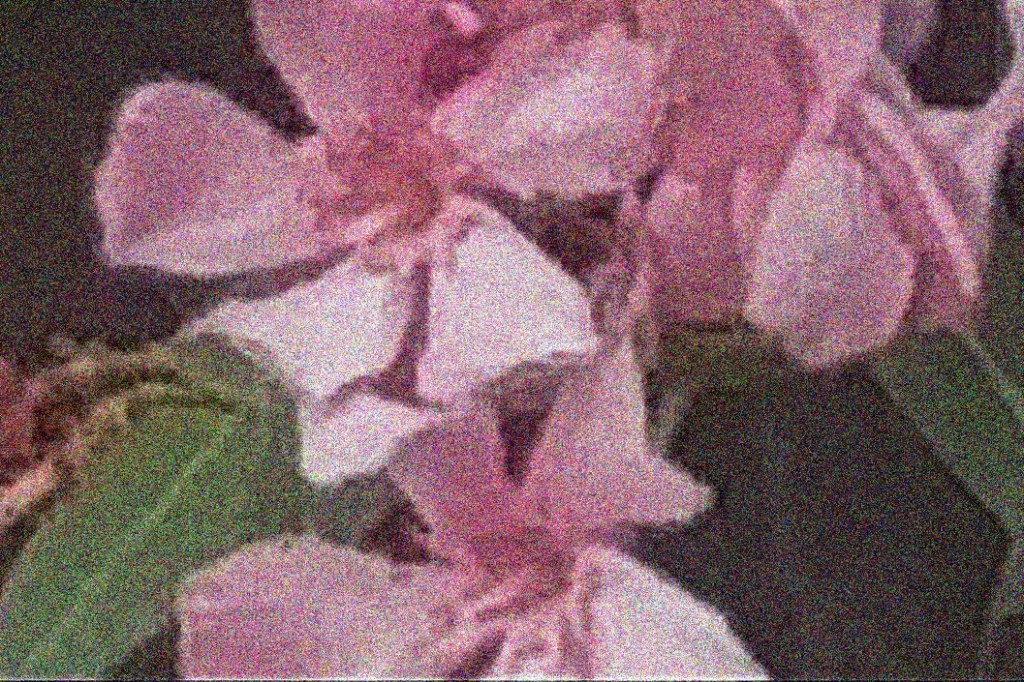
“Obviously, we all see life in 4k,” my middle school teacher casually remarked. The whole class nodded in unison, but I sat there thinking, “Erm, actually…”
Ever since I can remember, the world was composed of flickering, flashing dots, and the sky was littered with dancing floaters. I thought it was normal–or perhaps some kind of superpower (as a first-grader, I claimed I could see atoms)– but it turns out that I just had a rare disorder called Visual Snow Syndrome (VSS).
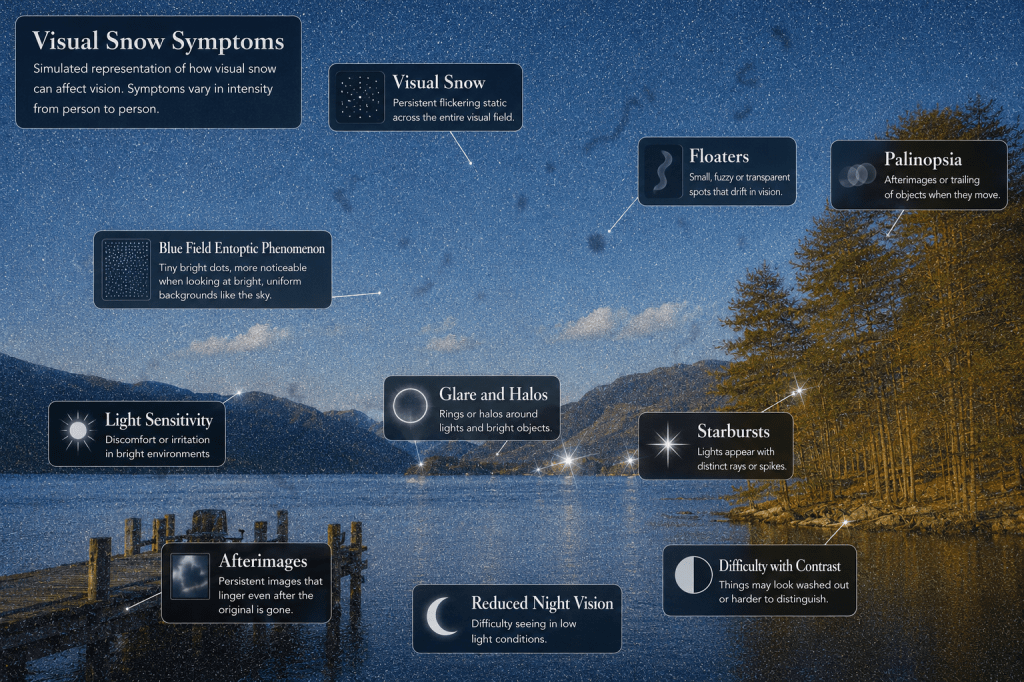
Visual Snow Syndrome is a chronic neurological condition that affects 2-3% of people worldwide. It’s characterized by visual static, a grainy appearance similar to an old television screen or a phone camera zoomed in all the way.
A number of symptoms often accompany VSS, including seeing trailing negative afterimages (palinopsia), drifting translucent “floaters” (caused by the shadows from clumps in the vitreous* of the eye) that becomes more prominent when looking at a bright blue sky, flashes of light (photopsia), abnormal light sensitivity (photophobia), and impaired vision at night (nyctalopia).
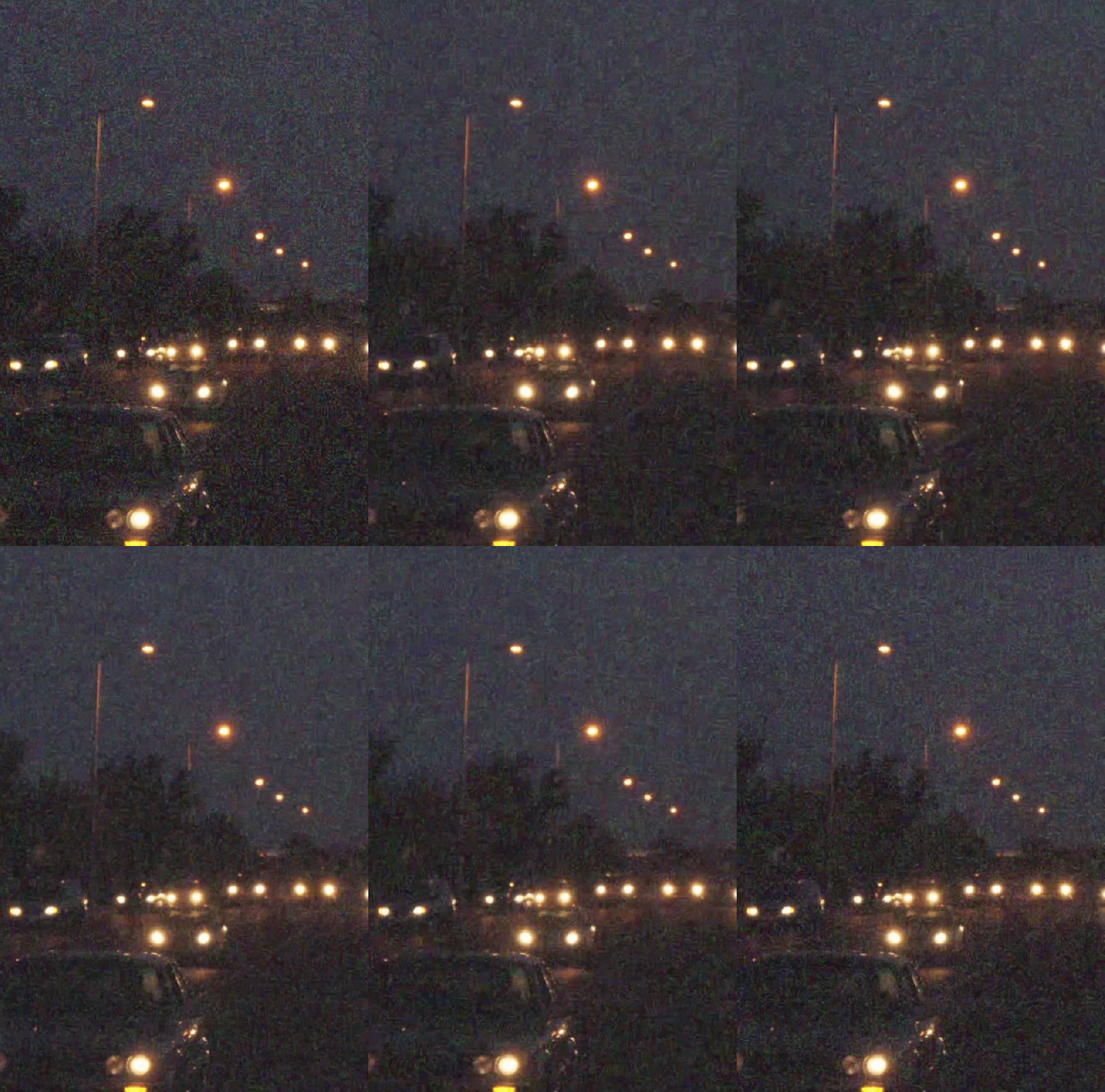

Right: A zoomed in phone camera lens can also simulate VSS

As VSS is still under study, its causes are only speculative. Most scientists agree that VSS is not caused by problems with the eye itself, but from issues in how the brain processes sensory information. Particularly, the thalamus (relays external signals) and the visual cortex (processes what you see) becomes disrupted. This causes unnecessary information that normally gets filtered out by the thalamo-cortical system to remain as visual “noise”. Also, hyperactivity of the visual cortex may contribute to VSS. When inhibitory neurotransmitters (“brain brakes”) such as GABA are reduced, neurons may fire more rapidly, producing excess visual output.
Although VSS is definitely not common, it may be more prevalent than we think due to a lack of public awareness. For decades, VSS has been dismissed in the medical community, causing many misdiagnoses. Before I learned about VSS, symptoms such as flashes of light and floaters caused significant anxiety because they can resemble signs of serious eye damage such as retinal detachment. Experiences like this demonstrate how a lack of understanding in the scientific and general community may lead to misunderstanding among patients.
Today, advocacy organizations such as Visual Snow Initiative (VSI) aim to raise awareness and conduct more research, hopefully discovering a cure to VSS in the near future.
I am fortunate enough to only have a mild case of this condition. Sometimes, I long to look up at a clear blue sky without flashing dots and random red streaks of light, but it doesn’t interfere with my daily life. On the other hand, others with the condition can experience debilitating symptoms that damage their quality of life. All across the severity gradium, people who suffer from VSS often feel alienated from the obscurity of their disorder and fear from the lack of knowledge on VSS.
On the whole, Visual Snow Syndrome highlights how intricate neurological pathways shape the way we perceive our surroundings. Even small changes to these complex, often mysterious processes can dramatically alter eyesight. As public awareness increases, people with VSS can feel less alone.
With more extensive research, the study of VSS can reveal previously undiscovered features of how the brain encodes external information.
*virtreous: gel-like substance inside the eye that helps with structural support
References:
Aeschlimann, Sarah A, et al. “Visual Snow Syndrome: Recent Advances in Understanding the Pathophysiology and Potential Treatment Approaches.” Current Opinion in Neurology, vol. 37, no. 3, 11 Mar. 2024, pp. 283–288, pmc.ncbi.nlm.nih.gov/articles/PMC11064904/, https://doi.org/10.1097/wco.0000000000001258.
“Eye Floaters – Symptoms and Causes.” Mayo Clinic, 2019, http://www.mayoclinic.org/diseases-conditions/eye-floaters/symptoms-causes/syc-20372346.
Nadeau, Fannie, and Guillaume Chabot. “Visual Snow Syndrome: A Perplexing Storm of Misperception.” American Academy of Ophthalmology, 1 Dec. 2024, http://www.aao.org/eyenet/article/visual-snow-neuro-ophthalmology.
“Visual Snow Syndrome (Static Vision).” Cleveland Clinic, 13 Nov. 2022, my.clevelandclinic.org/health/diseases/24444-visual-snow-syndrome.
“Visual Snow Syndrome: Sierra Domb’s Journey of Resilience.” Beacon for Rare Diseases, 29 Jan. 2026, http://www.rarebeacon.org/blog/turning-invisible-illness-into-visible-change-sierra-dombs-story-of-advocacy-living-with-visual-snow-syndrome/. Accessed 28 May 2026.


Leave a comment