
If you’ve ever tried to learn a new language before, you’ll know that it can feel like an entire brain workout. Linguistic abilities are rooted in a multitude of complex neural networks. When learning languages, the human brain is capable of actually reshaping itself in adapting to new neural connections, a phenomenon called neuroplasticity. First, let’s start with the evolutionary origins of human communication.
Many other species communicate with each other: for instance, honey bees perform a “waggle dance”, angling their bodies to signal the distance to a food source. Even plants can “speak” through chemicals called VOCs* which warn other plants of potential danger. But what makes human languages unique? Remarkably, we are able to communicate abstract concepts and ideas about the past or future, while most other organisms only react to immediate stimuli.
How did humans evolve from simple gestures and vocalizations to expressing complex emotions, discussing quantum mechanics, and telling imaginative stories? As civilizations progressed into large social societies, the ability to communicate well became central to survival and reproduction. Natural selection* favored individuals who possessed the brain capacity and neuroplasticity to form alliances, resolve disputes, share locations of water, coordinate hunting in a group, or teach others how to use certain tools. Words formed, and their meanings came from social agreement. This led to flexible, highly variable relationships between sounds and definitions across regions, and across generations as people acquired new vocabulary and pronunciations from their communities. Because it is transferred by learning instead of inheritance from DNA, language itself evolved through cultural shifts. not genetics. Thus, humans evolved to produce symbolic sounds and interpret a range of abstract meanings through biological selection and social learning.
Next, let’s discuss the neuroscience between the main four factors in language development: listening, speaking, reading, and writing.
- Listening
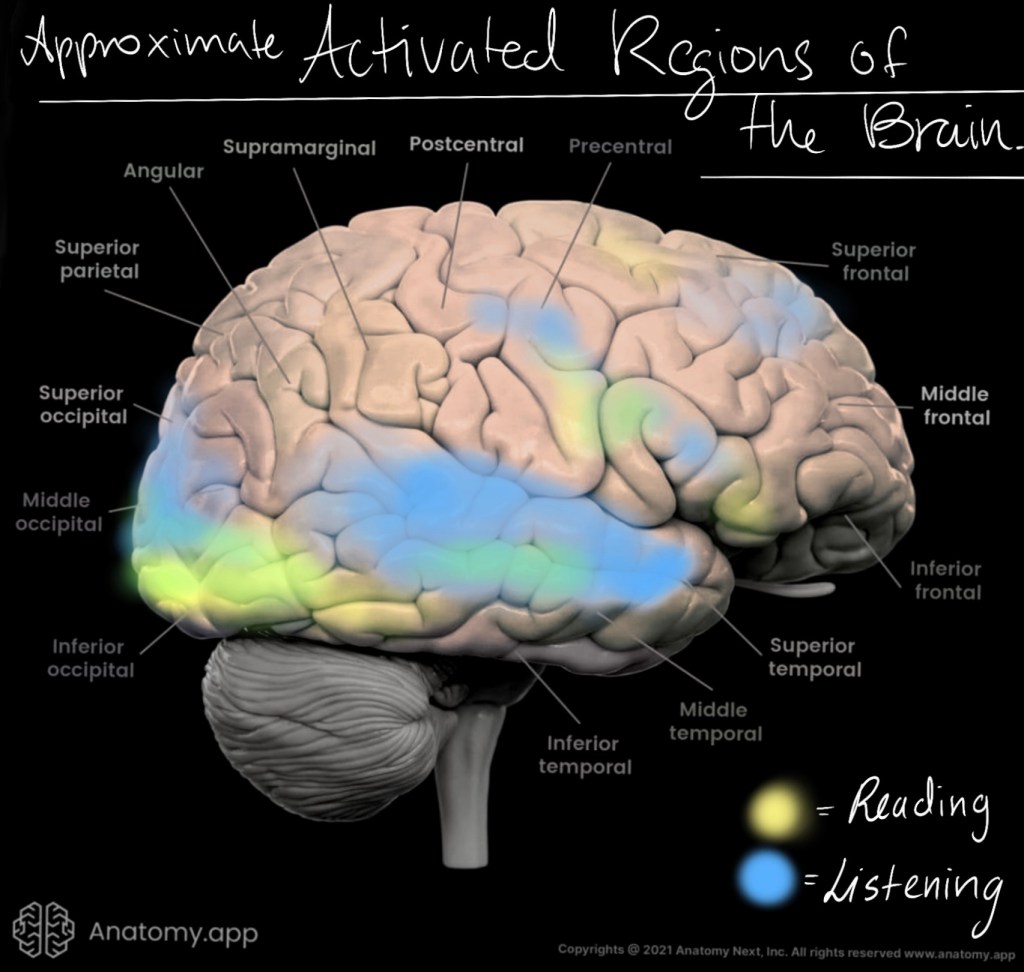
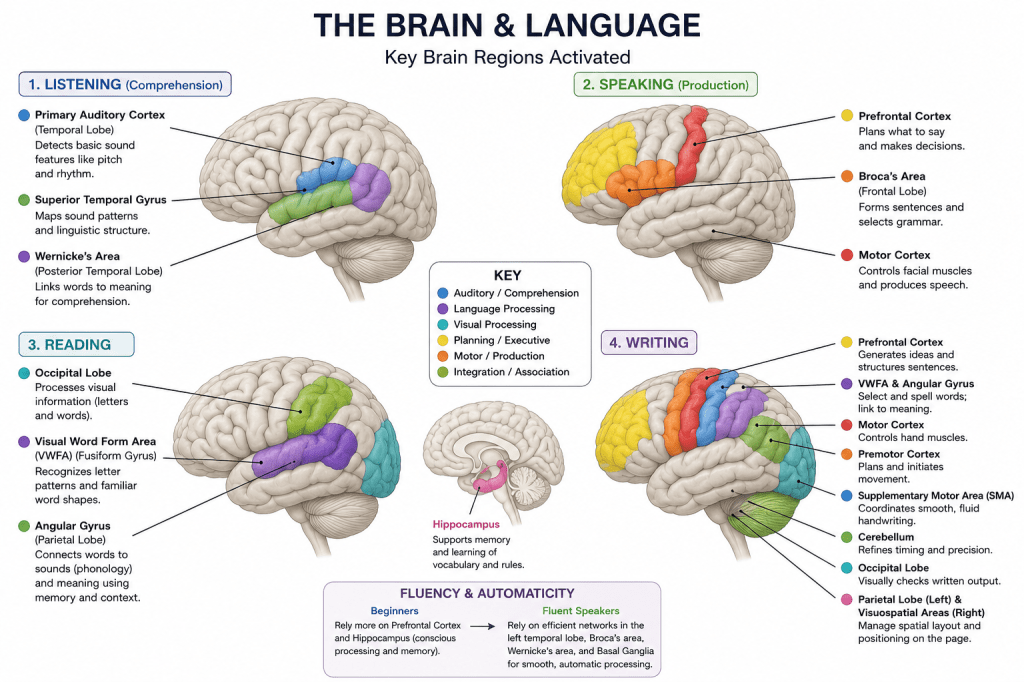
Comprehension requires processing sound waves into meaningful words and ideas. External auditory stimuli entering the ear are converted to neural signals in the primary auditory cortex, which recognizes general qualities of speech, such as pitch or rhythm. As signals travel to the superior temporal gyrus, linguistic patterns begin to be mapped out. Finally, Wernicke’s area in the posterior temporal lobe matches auditory input with meaning, allowing for deep comprehension. When this area is damaged, resulting in Wernicke’s aphasia, individuals can speak smoothly, but their sentences lack meaning. Without this advanced internal processing, people with the condition struggle to comprehend spoken language.
- Speaking
Before speaking, we plan out what to say using the prefrontal cortex of the brain, the primary “command center” for decision making. Located in the frontal lobe of the cerebrum, Broca’s area is critical for the formation of sentences and selecting correct grammar structures. The motor cortex, also in the frontal lobe, uses the organized information from Broca’s area to move facial muscles and produce speech. When the frontal lobe and Broca’s area is damaged, individuals can form sentences in their head, but have trouble articulating them aloud, usually only capable of telegraphic speech (1-4 words long).
- Reading
Reading relies on the ventral stream, a pathway traveling through the occipital and temporal lobes. Text begins processing in the occipital lobe, which takes in visual information. This information is passed to a special region of the fusiform gyrus called the visual word form area (VWFA). The VWFA recognizes the structure of letters, grouping them into familiar words. Then, the angular gyrus located in the parietal lobe (near the upper back of the brain) pairs words with their phonetic pronunciations and meanings using memory and context. Reading and listening share notable neurological overlap, such as passing through the temporal lobe during sensory processing.
- Writing
Writing is an intensely cognitively demanding skill, with many neurological systems involved. To begin with, the prefrontal cortex gathers thoughts and forms sentences using learned vocabulary and grammar. The left hemisphere language network, which includes the VWFA and the angular gyrus, helps with selecting and spelling words. Physically writing words involves the primary motor cortex, which controls hand movement, while the premotor cortex initiates the types of movement. The supplementary motor area coordinates smooth handwriting by activating specific muscles and preventing unwanted motions. The cerebellum assists with timing and further fluidity when writing. To visually assess one’s writing, the occipital lobe processes written letters, and the VWFA retrieves stored memories of word shapes. Finally, the parietal lobe in the left hemisphere and visuospatial processing areas in the right hemisphere of the brain analyze the spatial positions of words on paper.
You might have heard that writing things down is a better way to absorb information than simply typing it on a keyboard. This is because handwriting uses more fine motor skills, movement planning, and visuospatial organization, especially for hieroglyphic or logographic languages, such as Egyptian or Chinese.
As a current speaker or learner of five different languages to varying degrees of fluency, I’ve always wondered: What is the neurological threshold between casual learners and native-adjacent fluency? Fluency can be characterized by a dominance in automatic and subconscious processing. Some people believe that if you can dream in a language, it signals that you’re fluent in it. There is slight truth to this: during sleep, areas of the brain associated with language or memory, including the temporal lobe and hippocampus, remain active. However, languages spoken in dreams are usually vague and fragmented, indicating a deep internalization of language patterns rather than proof of fluency. While neurological markers of fluency are still under study, research suggests that beginners rely more on the prefrontal cortex and hippocampus, consciously recalling vocabulary and grammar rules from memory; on the other hand, fluent speakers use more efficient language processing networks in the left temporal lobe, Broca’s area, Wernicke’s area, and basal ganglia for smooth articulation.
All in all, human language evolved to include complex neurological pathways across the brain. From comprehension to internal processing to visual perception, a relay of neural signals translate words into meanings, and transform thoughts into expression. Through the extraordinary neuroplasticity of our brains and lots of language exposure, we can reprogram these systems to become efficient and effortless.
*Volatile organic compounds
*Natural Selection: the process in which individuals with traits more advantageous to survival and reproduction in their environment are more likely to pass on their genetic material, leading to evolution in a population over time
Citations:
Buchweitz, A., Mason, R. A., Tomitch, L. M. B., & Just, M. A. (2009). Brain activation for reading and listening comprehension: An fMRI study of modality effects and individual differences in language comprehension. Psychology & Neuroscience, 2(2), 111–123. https://doi.org/10.3922/j.psns.2009.2.003
Cafasso, J. (2019, May 17). What Part of the Brain Controls Speech: Several Parts of the Cerebrum. Healthline. https://www.healthline.com/health/what-part-of-the-brain-controls-speech#takeaway
Catalano, J. (2019, October 31). Plants use a common “language” for emergency alerts | Department of Ecology and Evolutionary Biology. Cornell.edu. https://ecologyandevolution.cornell.edu/news/plants-use-common-language-emergency-alerts
Marano, G., Kotzalidis, G. D., Lisci, F. M., Anesini, M. B., Rossi, S., Barbonetti, S., Cangini, A., Ronsisvalle, A., Artuso, L., Falsini, C., Caso, R., Mandracchia, G., Brisi, C., Traversi, G., Mazza, O., Pola, R., Sani, G., Mercuri, E. M., Gaetani, E., & Mazza, M. (2025). The Neuroscience Behind Writing: Handwriting vs. Typing—Who Wins the Battle? Life, 15(3), 345–345. https://doi.org/10.3390/life15030345
Michael Ullman (2001). The Declarative/Procedural Model of Lexicon and Grammar
samart33. (2017, June 13). Bee Communication. Askabiologist.asu.edu. https://askabiologist.asu.edu/honey-bee-communication
Speech & Language. (2025). Memory and Aging Center. https://memory.ucsf.edu/brain-health/speech-language


Leave a comment