
Along with statistics, calculus is a mathematical powerhouse in life sciences. Continuous change is found everywhere in living systems, from bacterial growth to predator-prey dynamics. This article is a brief introduction to fields where calculus is crucial, as well as foundational differential equations in biology.
- Pharmaceutics
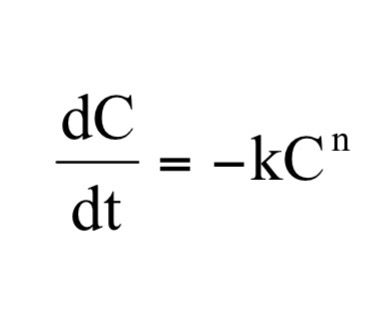
In particular, pharmacokinetics studies the absorption and effects of drugs over time. Differential calculus, which measures how variables change with respect to each other (such as concentration and time), is important for calculating the dose and frequency of treatments. For example, this differential equation can be used to model the rate of change relative to the concentration of a drug over time, effectively computing three variables to find the optimal dosage.
- Population Studies
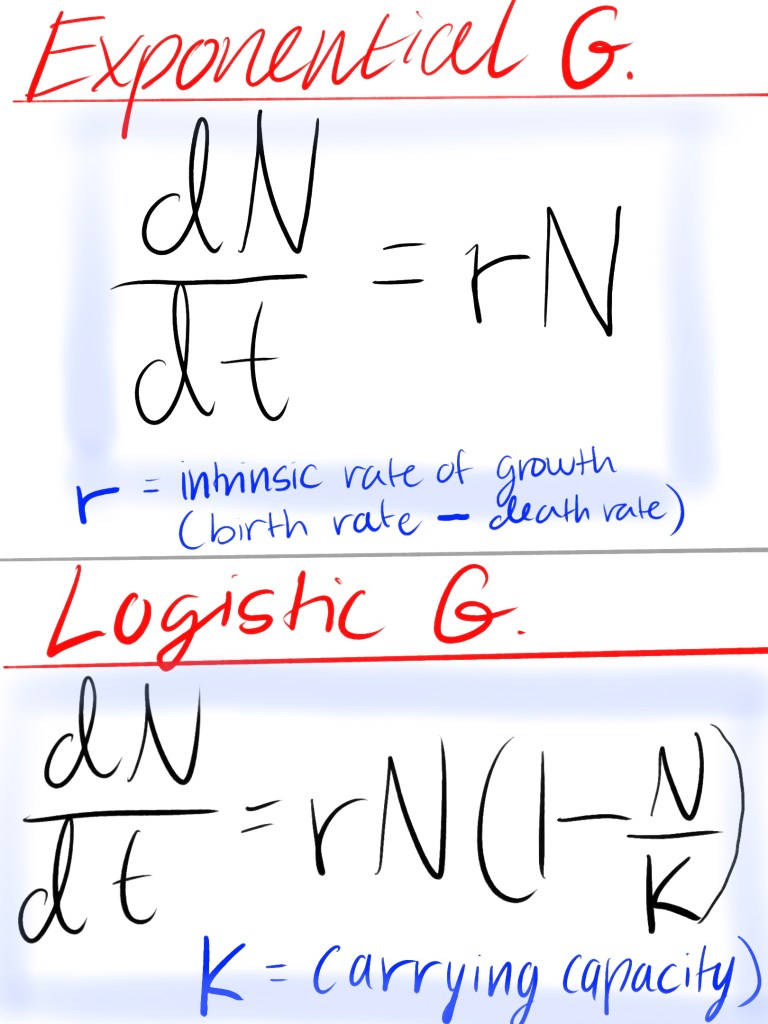
The famous models for exponential and logistical growth* are actually based on differential equations. These equations can be used to calculate instantaneous rate of change over time, or the population size at each fraction of a second.
However, to calculate total population change over time, we must use integration. Using differential calculus for modeling population growth is essential—not just for tracking organisms in a large ecosystem, but also bacterial/viral growth, and predicting tumor growth in patients with cancer.
- Synthetic Biology
Synthetic biology is an emerging field in genetic engineering. It takes biological systems and breaks them down into their components, such as separating promoters and terminators from genetic sequences. This allows artificially synthesized genes to replace sequences precisely for predictable results. For instance, in the top-down approach, biologists take existing organisms, such as a yeast cell, and genetically modify it so that it can produce chemicals for medical use.
Where is calculus used? Ordinary Differential Equations (ODEs) are utilized in describing how the concentrations of biological molecules (ie. proteins, mRNA) change over time. Using this information, complex networks of coupled genes and feedback loops can help maximize the yield of metabolic pathways.
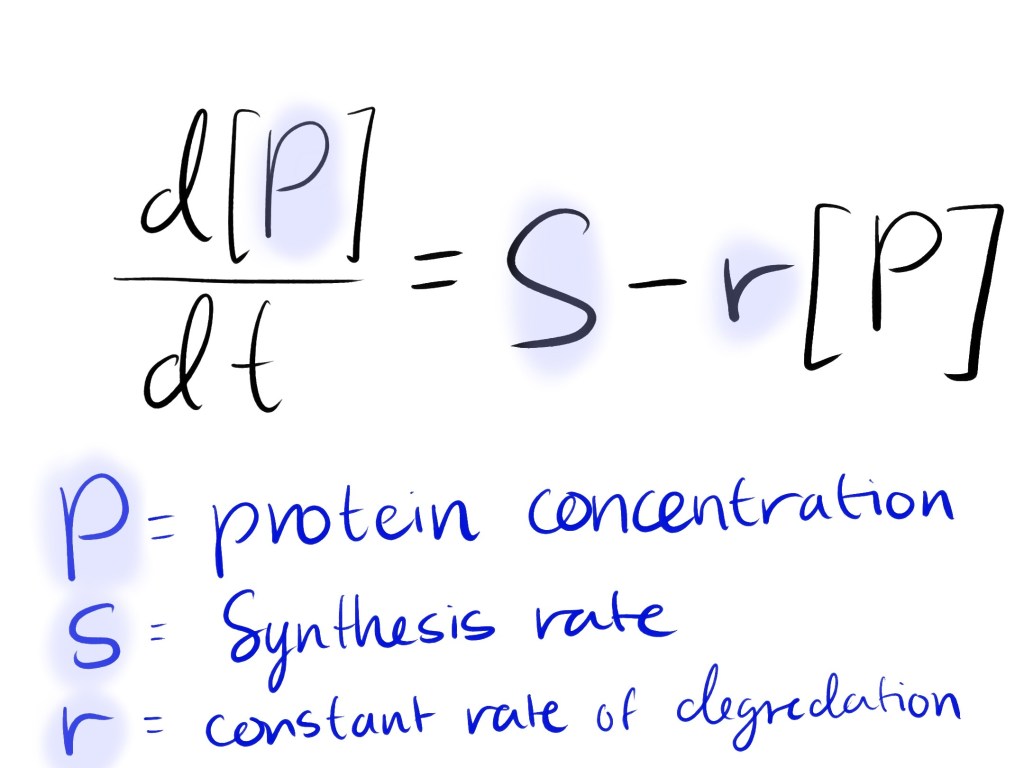
Furthermore, differential equations can identify the “dials” to optimize biological models. First, deterministic differential equations (ODEs) can track the large-scale, average concentrations in species over time. On the other hand, stochastic differential equations (SDEs) quantify “noise” and variability in cells. It analyzes the sensitivity of models to random fluctuations, helping to ensure the stability of a system, or interpret any failures to work as expected.
Calculus plays a hidden but indispensable role in helping scientists observe patterns within living systems. By gathering data on constantly changing environments, differential equations provide quantifiable answers to life-changing questions. As more knowledge is obtained and as biotechnology advances, calculus can be relied upon to provide structure to new models and developments in medicine.
*logistic growth: population growth constrained by a carrying capacity (K). In other words, as the population increases, the growth rate decreases due to insufficient resources.
Sources:
Arpino, J. A. J., Hancock, E. J., Anderson, J., Barahona, M., Stan, G.-B. V., Antonis Papachristodoulou, & Polizzi, K. (2013). Tuning the dials of Synthetic biology. Microbiology, 159(Pt_7), 1236–1253. https://doi.org/10.1099/mic.0.067975-0
Jarrett, A. M., Lima, E. A. B. F., Hormuth, D. A., McKenna, M. T., Feng, X., Ekrut, D. A., Resende, A. C. M., Brock, A., & Yankeelov, T. E. (2018). Mathematical models of tumor cell proliferation: A review of the literature. Expert Review of Anticancer Therapy, 18(12), 1271–1286. https://doi.org/10.1080/14737140.2018.1527689
Mathematics in Pharmacokinetics. (n.d.). University of Florida. Retrieved July 22, 2026, from https://pharmacy.ufl.edu/files/2013/01/Basic-Pharmacokinetics.pdf
Roberts, M. A. J., Cranenburgh, R. M., Stevens, M. P., & Oyston, P. C. F. (2013). Synthetic biology: Biology by design. Microbiology, 159(Pt 7), 1219–1220. https://doi.org/10.1099/mic.0.069724-0
Wang, Le Z., Wu, F., Flories, K., Lai, Y.-C., & Wang, X. (2026). Build to Understand: Synthetic Approaches to Biology. Nih.Gov. https://pmc.ncbi.nlm.nih.gov/articles/pmc4837018/


Leave a comment