
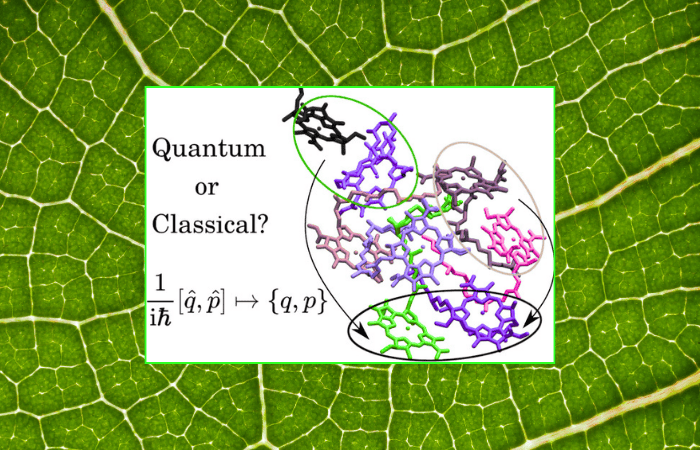
Photosynthesis is both a widespread biological process and a universal household name. Nearly everyone knows photosynthesis as the process where plants convert sunlight into usable chemical energy. What secondary school doesn’t teach about photosynthesis is the strange and messy quantum dimension underneath this familiar process. Decoding the mystery to how plants achieve near-perfect energy efficiency could even reveal exciting new models in bionic engineering.
- Energy Transfer: Textbook vs. Reality
Energy transfer in photosynthesis is portrayed in introductory classes as light energy hitting a chlorophyll molecule in the LHC (light harvesting complex), exciting an electron (which becomes an exciton), and causing energy to hop randomly from one chlorophyll molecule to the next.
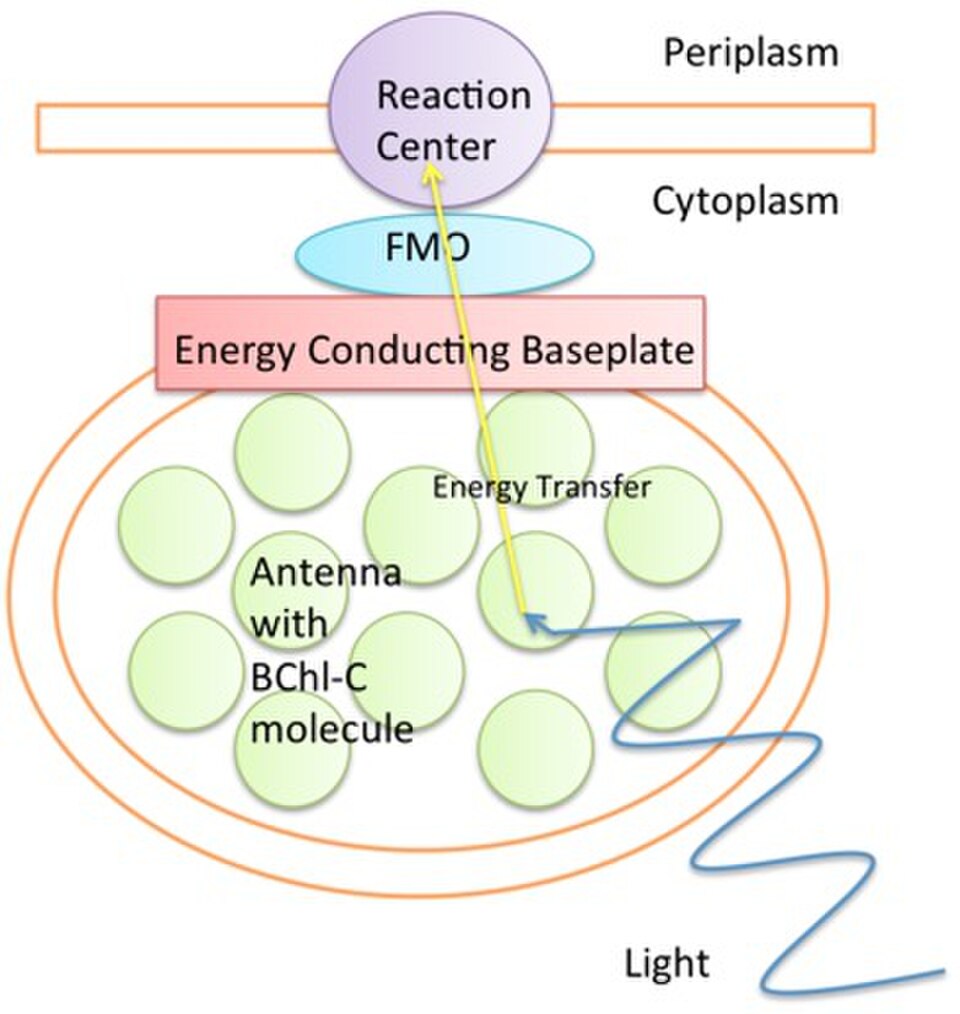
If the movement of energy was truly random, it would lose significant amounts of energy as heat or fluorescence along the way to the reaction center. However, plants have nearly perfect quantum efficiency, where close to 100% of energy absorbed from photons results in stable products (i.e. NADPH, ATP, oxygen gas). Newer research using spectroscopy measurements on a femtosecond (10⁻¹⁵ or 1/1,000,000,000,000,000 of a second) time scale indicates that excited electrons can enter a state of quantum superposition, creating wave-like patterns that activate multiple pathways all at once. Quantum biology experiments also showed that electrons can explore pathways reversibly, meaning they can turn back after entering a wrong pathway without any losses.
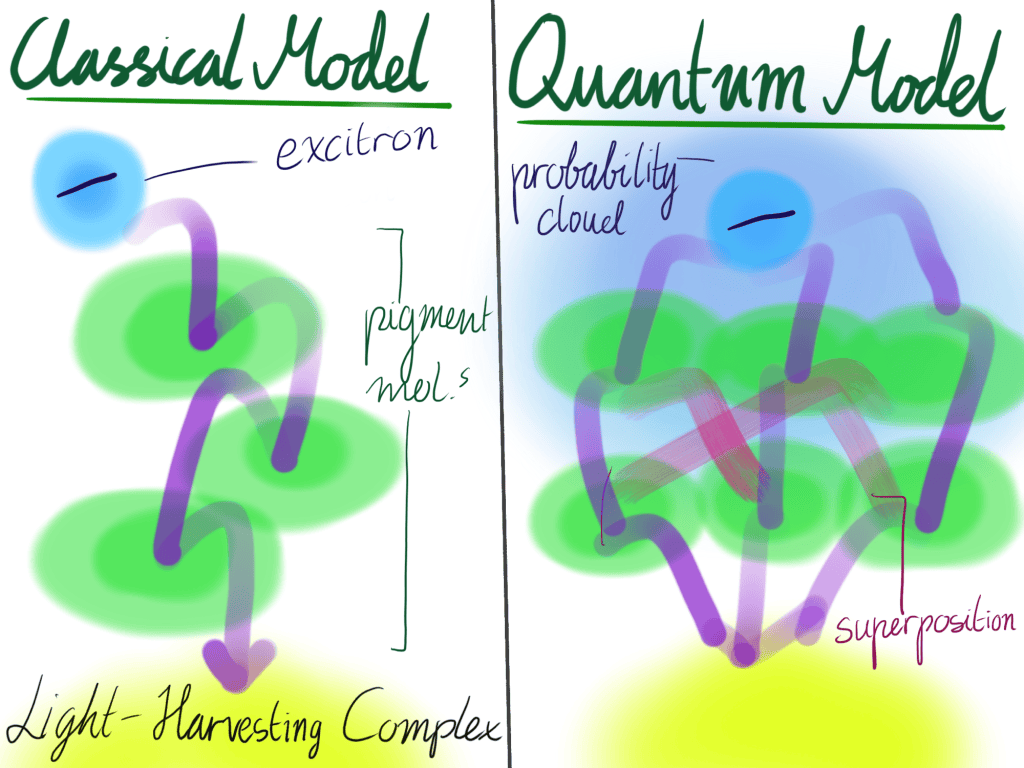
Furthermore, when photons hit the LHC antenna, energy does not only transfer to a single chlorophyll molecule. Through quantum delocalization, the exciton is spread across many molecules simultaneously. This can be thought of as a cloud of energy hovering over a cluster of molecules, allowing the plant to absorb broader spectrums of light than an isolated chlorophyll molecule could. Ultimately, quantum models provide a more persuasive explanation on the immense energy efficiency during photosynthesis.
- Handling Chaos: Quantum Coherence
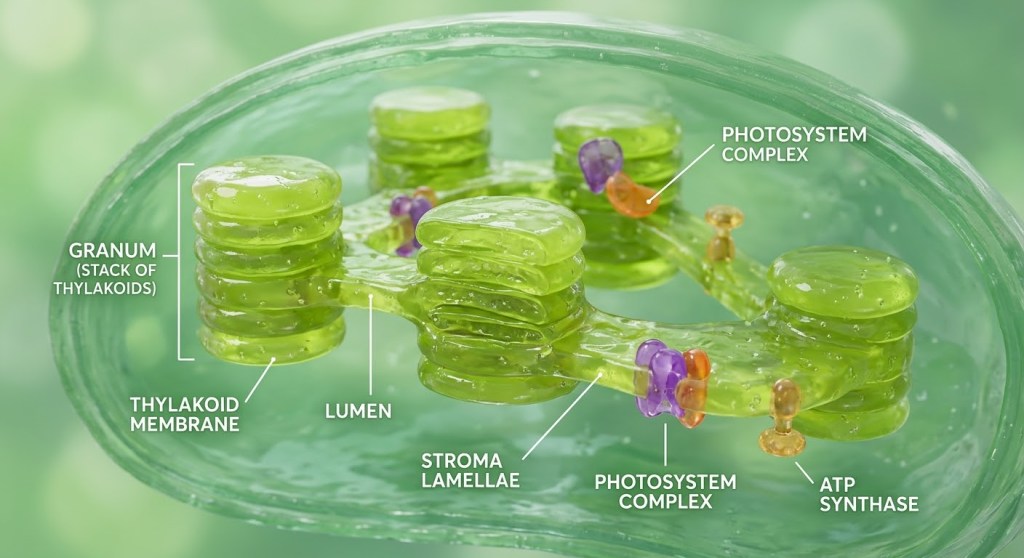
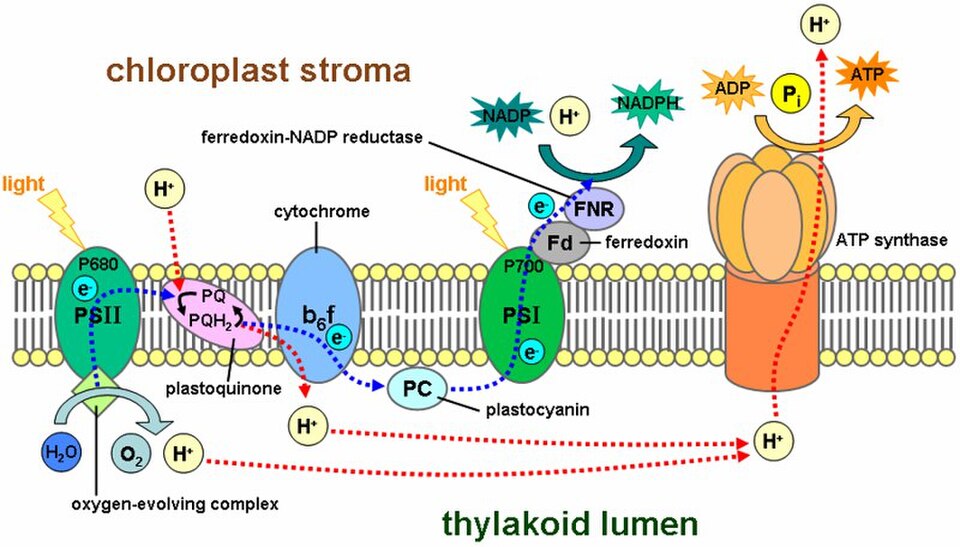
Usually, forming quantum properties requires freezing cold temperatures (just a fraction above 0 Kelvin or -273.1°C) and specialized laboratory vacuums. Therefore, physicists were stunned that a warm, moist plant leaf could perform sustained quantum effects. While a leaf cannot maintain pure, wavelike electronic quantum states, quantum properties survive because plants utilize natural vibrations in their environment to physically funnel energy. Plant proteins use coherent molecular vibrations to synchronize energy transfer pathways, preventing decoherence, the loss of a quantum state. Modern studies also suggest that vibronic mixing, the blend of electronic and vibrational states, helps guide energy flow through a multicomplex protein environment rather than an isolated quantum system. This complex forms through quantum entanglement, where interactions between dipoles, called dipole coupling, links the quantum states of individual pigment molecules into a collective system. Additionally, the LHC contains scaffolding proteins that hold chlorophyll molecules together, acting as barriers protecting quantum states from chaotic thermal noise. It binds the pigments into rigid geometric arrangements, preventing them from shifting randomly. This limits how much cellular chaos can disrupt energy pathways, allowing for efficient energy transfer.
- Solar Panels: Real World Applications

Grasping more of the quantum secrets of photosynthesis contributes to modern blueprints in bio-inspired engineering. Current solar panels have limited energy transfer efficiency–almost 70% of absorbed sunlight is lost before converting to electricity, mostly through heat. As the physics theory called the Shockley-Queisser limit states, a single-junction solar cell can only convert up to 33.7% of sunlight into usable energy. As knowledge of plant energy transfer increases, scientists are considering utilizing quantum interference, a property where electrons behave like waves that ripple and interfere with one another, to potentially improve light absorbance and reduce electron recombination (when combining free electrons with a positive charge carrier causes both to neutralize or disappear). Theoretically, this system could generate 35% more energy than a solar cell operating solely on classical physics. However, the model has not been built in real life yet, as such systems are complicated to synthesize and may still have ways where energy could be lost. Even so, these innovative ideas could pave the way for an efficient solar energy source.
For centuries, biology was described almost exclusively in classical terms. As the intersection of quantum mechanics and biology emerges, scientists can better understand previously enigmatic biological processes such as photosynthesis, avian magnetoreception (bird navigation), photoreceptors in vision, and cellular respiration. Applying quantum theories to living systems reveals the complex, chaotic reality behind commonly simplified, seemingly linear systems, and makes pioneering quantum-biological technology possible in the near future.
Works Cited:
Brown, C. (2026, March 3). Quantum cooling for quantum computing – electrical and computer engineering. Electrical and Computer Engineering. https://ece.ncsu.edu/2026/quantum-cooling-for-quantum-computing/
Cao, J., Cogdell, R. J., Coker, D. F., Duan, H.-G., Hauer, J., Kleinekathöfer, U., Jansen, T. L. C., Mančal, T., Miller, R. J. D., Ogilvie, J. P., Prokhorenko, V. I., Renger, T., Tan, H.-S., Tempelaar, R., Thorwart, M., Thyrhaug, E., Westenhoff, S., & Zigmantas, D. (2020). Quantum biology revisited. Science Advances, 6(14), eaaz4888. https://doi.org/10.1126/sciadv.aaz4888
Choi, C. (2014, January 7). Quantum effects of photosynthesis could improve energy efficiency. AIP. https://www.aip.org/inside-science/quantum-effects-of-photosynthesis-could-improve-energy-efficiency
dankrotz. (2007, April 12). Quantum secrets of photosynthesis revealed – berkeley lab. Berkeley Lab News Center. https://newscenter.lbl.gov/2007/04/12/quantum-secrets-of-photosynthesis-revealed/
Kristiansen, A. (2019, February 4). The future of Quantum Biology | Royal Society. Royalsociety.Org. https://royalsociety.org/blog/2019/02/the-future-of-quantum-biology/
lcyarris. (2010, May 10). Untangling the quantum entanglement behind photosynthesis: Berkeley scientists shine new light on green plant secrets – Berkeley Lab. Berkeley Lab News Center. https://newscenter.lbl.gov/2010/05/10/untangling-quantum-entanglement/
Orcutt, K. (2021). Plants do the wave. Berkeleysciencereview.Com. https://berkeleysciencereview.com/article/2021/11/30/plants-do-the-wave
Sayers, J. (2026, October 30). Scientists crack solar panels” 33% efficiency ceiling. BGR. https://www.bgr.com/2301659/scientists-crack-solar-panels-efficency-ceiling/
Schirber, M. (2009). The quantum dimension of photosynthesis. Physics, 23. https://physics.aps.org/story/v23/st5
Zhang, Y., Oh, S., Alharbi, F. H., Engel, G., & Sabre, K. (2014). Delocalized quantum states enhance photocell efficiency (1411.0713V1). arXiv. https://doi.org/10.1039/C4CP05310A


Leave a Reply